
[Very Important Coding Interviews : Heap & Priority Queue#05] How To Solve ANY Heap & Priority Queue Programming Question ( Pattern Approach with Shortcuts) : How it Works ( With Implementation Code)
Everything you MUST know to solve any Heap & Priority Queue question...
This is the best hands-on guide you will ever find on Heap & Priority Queue Technique which follows Pattern based Approach to Solve any Heap & Priority Queue question and Shortcuts You MUST READ and Implement.
Objective : Master all Heap & Priority Queue patterns that appear in 100% of coding interview problems.
Table of Contents
Introduction: Understanding Heaps and Priority Queues
Pattern 1: Top K Elements - Selection Problems
Pattern 2: Two Heaps - Median Finding
Pattern 3: Merge K Sorted - K-way Merge
Pattern 4: Scheduling with Heaps
Pattern 5: Stream Processing - Continuous Data
Pattern 6: Frequency-Based Heap
Pattern 7: Interval Management with Heaps
Advanced Patterns and Techniques
Company-Specific Problem Index
Interview Strategies and Templates
Shortcuts
Note : Each pattern comes with its Python Implementation ( can be found as you scroll) and at the end of thus post along with Heap & Priority Queue Shortcuts and problem examples.
—-
Practice your Interview with God Level Feedback Quantum —
On Quantum you can Practice FAANG-level questions with complete system design breakdowns, full architectures, trade-offs, and key concepts with God level feedback.
Also on live on product hunt - Quantum
Learn more patterns and shortcuts for each coding problem type —
Read ( major compilations of LLM System Design, ML System Design and 300+ Implemented Projects) —
[Important Bookmark] Compilation of All Implemented Projects ( with Code Implementation Files)
Introduction: Understanding Heaps and Priority Queues
What is a Heap?
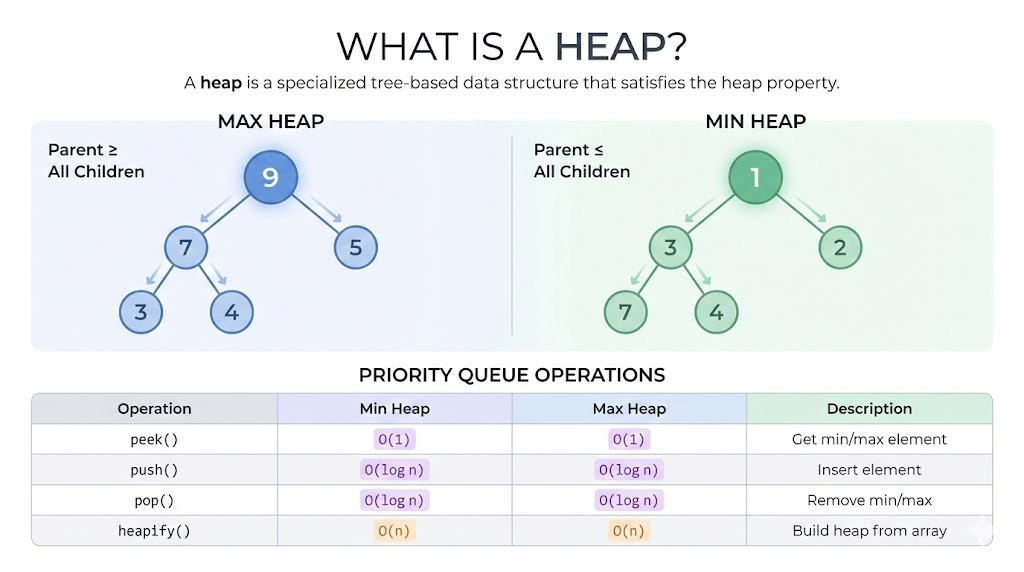
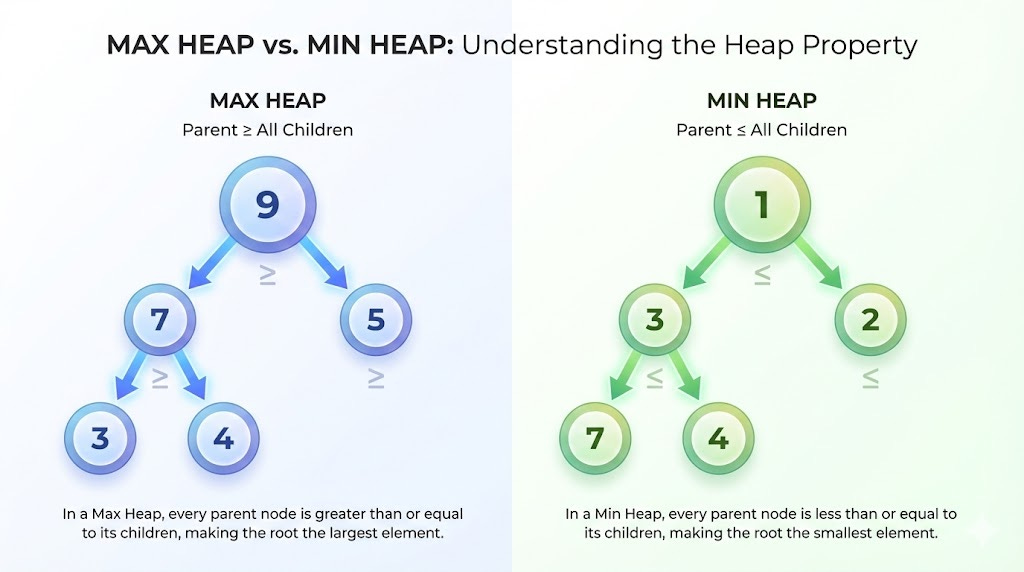
A heap is a specialized tree-based data structure that satisfies the heap property:
Max Heap:
Parent ≥ All Children
       9
      / \
     7   5
    / \
   3   4
Min Heap:
Parent ≤ All Children
       1
      / \
     3   2
    / \
   7   4
Priority Queue Operations
Operation Min Heap Max Heap
Description
peek() O(1) O(1) Get min/max element
push() O(log n) O(log n) Insert element
pop() O(log n) O(log n) Remove min/max
heapify() O(n) O(n) Build heap from array
Python’s heapq Module
Important: Python’s heapq is a MIN HEAP only!
import heapq

# Min Heap (default)
min_heap = []
heapq.heappush(min_heap, 5)
heapq.heappush(min_heap, 3)
heapq.heappush(min_heap, 7)
print(heapq.heappop(min_heap))  # 3 (smallest)

# Max Heap (negate values)
max_heap = []
heapq.heappush(max_heap, -5)
heapq.heappush(max_heap, -3)
heapq.heappush(max_heap, -7)
print(-heapq.heappop(max_heap))  # 7 (largest)

# Heapify existing list
nums = [3, 1, 4, 1, 5]
heapq.heapify(nums)  # O(n) - better than n insertions